
Electrical Engineer Resume Example, Template, and Format
Electrical engineers need an excellent resume to land the right job. Follow these expertly prepared electrical engineer resume examples and resume writing tips to create your own strong resume.

Our customers have been hired by:*Foot Note





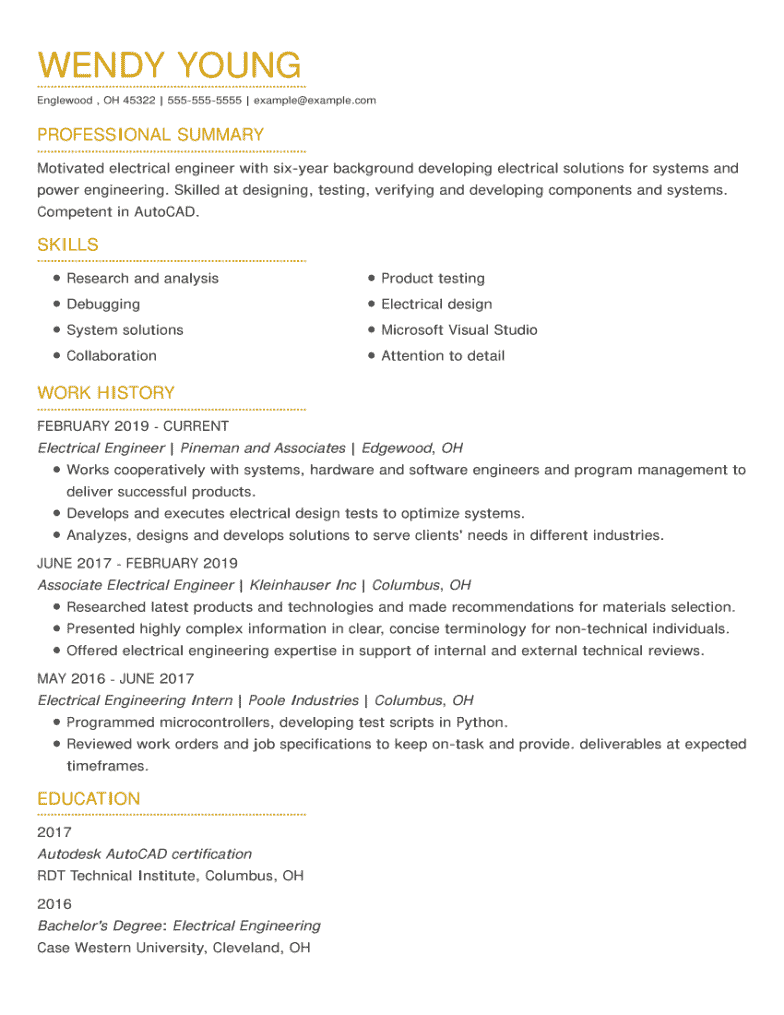
Electrical engineer resume example
Put together a strong electrical engineering resume using this example's structure and organization.
Resources for Your Next Career Move
Explore our complete resume examples selection for tips and resources tailored to every career path.
Customer Reviews You Can Trust
Five keys for a successful electrical engineer resume
Follow these five keys to build a well-written electrical engineer resume.
Match your abilities and qualifications to the job
When career experts suggest that job candidates customize each resume for every job application, it’s not to give you more work. It’s because within each job description, there are important qualification-related keywords that must be included in your resume. Employers use applicant tracking systems (ATS) to select qualified candidates based on keywords. For example, if a job posting requires you to have “knowledge of commercial building construction and local building codes and a keen understanding of renewable energy,” address those keywords in your job application documents, including your resume and cover letter.
Emphasize results and achievements
On a resume, your first impulse might be to list out your daily tasks. However, consider that other electrical engineer candidates will probably feature similar work experiences on their resumes. To stand out, list your most impressive accomplishments: unique highlights of your electrical engineering career that can be told using quantifiable numbers. For example: “Designed, developed and implemented an automated control system, resulting in a 21% increase in production efficiency.”
Show you have the right combination of technical and soft skills
Your electrical engineer resume should emphasize your hard skills and soft skills to show you have the technical qualifications and the traits representing a good work ethic and the ability to work efficiently along with a team of engineers. Hiring managers will be looking for hard skills like electrical code compliance, circuit design and analysis and programmable logic controllers (PLCs). Soft skills for engineers would include problem-solving, critical thinking and project management. Look further down on this page for more electrical engineering skills to consider including in your resume.
List any related certifications or credentials you have
In addition to highlighting your impressive engineering degrees, you can also add a separate section to your resume to mention any certifications (e.g. AutoCAD or MATLAB certificate) or additional training that proves your technical expertise as an electrical engineer. It’s also wise to include your state-issued Professional Engineer (PE) license or Project Management Professional (PMP) certification, if applicable.
Skip any inclusion or mention of references
Your references won’t matter until later in the application process. Including them on your resume or even adding a "references available upon request" line is merely using up page space needlessly. Besides, it’s rare for any employer to investigate your background before they interview you. If your potential employer requests references with the application, send them in a separate document.
Action words for your electrical engineer resume
Hiring managers don’t want to read resume after resume with a boring laundry list of electrical engineering experience. Instead, communicate your career highlights using action-packed verbs, energizing energize accomplishments in both your summary and work experience sections. For example: “Executed system level requirements analysis, sub-system level requirements development and conceptual design.”).
Here are action words for an engineering resume:
- Achieved
- Administered
- Analyzed
- Arranged
- Calibrated
- Collaborated
- Conceptualized
- Configured
- Created
- Customized
- Debugged
- Designed
- Developed
- Directed
- Drafted
- Established
- Evaluated
- Executed
- Expanded
- Expedited
- Facilitated
- Formulated
- Generated
- Implemented
- Improved
- Innovated
- Inspected
- Integrated
- Interpreted
- Maintained
- Managed
- Negotiated
- Optimized
- Organized
- Pioneered
- Planned
- Prepared
- Programmed
- Proposed
- Resolved
- Restored
- Simulated
- Solved
- Supervised
- Tested
- Transformed
- Troubleshot
- Upgraded
- Validated
Choose the right format for your resume
Before you begin building your electrical engineer resume, you need to select the best resume format for your situation. A chronological resume format focuses on work history, while a functional resume format will emphasize skills. The combination resume format, also known as the hybrid format, highlights a combination of work history and skills.
Here is a guide to selecting the best resume format for your engineering career level:
Experienced electrical engineer
The reverse-chronological resume format highlights your years of engineering experience as well as relevant skills.
Recent graduate/entry level
The functional resume format shifts the focus off your work experience (or lack of experience) by highlighting your relevant transferable skills instead.
Experienced/gap in employment history/career changer
The combination format equally prioritizes experience and skills.

20 key skills for your electrical engineer resume
An electrical engineer resume needs to feature a well-rounded list of hard skills and soft skills. Your hard skills are those engineering abilities learned through acquiring your degree and on-the-job training, while soft skills are the personality-driven traits that make up who you are as a person.
Here are some electrical engineer skills to include on a resume:
- Engineering design
- Project management
- Computer skills/Programming
- Technical skills
- AutoDesk AutoCAD
- Engineering Design
- MATLAB
- Programmable Logic Controllers
- Automation
- Physics
- Mathematical skills (e.g., calculus, linear algebra)
- Strategic thinking
- Analytical thinking
- Innovative thinking
- Communication skills
- Data analysis
- Time management
- Leadership skills
- Problem-solving skills
- Presentation skills
How to write an electrical engineer resume
Here are the steps to building a well-written resume:
Resume header
Your contact information is presented in the header of your resume. The hiring manager should be able to easily locate your information to set up a job interview. Include links to your career networking portfolios like Linkedin or a portfolio that displays your technical skills. Browse the electrical engineering resume samples to see different examples of headers.
Resume summary or objective
A resume summary is a short statement about the work you have done in the past. A resume objective includes this as well as your goals for the job if you get hired. Which one you choose to use can depend on how many years of experience you have in the industry already. A more experienced engineer will write a resume summary. An entry-level, recent electrical engineering graduate, career changer or engineer with less experience will write a resume objective. Remember to focus on the value you can bring to the company.
Resume skills section
Be specific in your skills section by listing soft skills and hard skills relevant to the position, especially those listed in the job description. Make an impact by using bullet points to list your most impressive skills and don’t fill your skills section with skills unrelated to the position.
Here are a few bullet points you may want to include:
- Electrical circuit design
- CAD software
- Electrical load calculations
- Project management
- Programmable logic controllers
- AutoCAD
- LabVIEW
- MatLab
- Data collection
- Data analysis
- Circuit design
- Communication skills
- Teamwork
Resume work history
Include up to the last 10 years of relevant engineering experience in your work history section. Relevant experience is typically defined as work from the same industry. However, as an engineer, you may include work that has similar skills such as project management, computer programming or design. You can expand on any work history older than 10 years in your Linkedin or other online profile. Remember to include your profile links in the resume header with your other contact information.
Ordinarily, you should shoot for 3-5 bullet points per job.
Education on resume
In your resume education section, include all levels of higher education including your electrical engineering certifications. The extras like a master’s degree and certifications can elevate you over job candidates who only hold a bachelor’s degree and lack engineering certifications. This may even earn you a higher salary for holding extra credentials. Also, be sure to include academic honors you received such as cum laude or dean’s list.
Build my resumeDo’s and don’ts for an electrical engineer resume


- Customize your resume's job description examples to closely match the responsibilities of the job you are applying for.
- Demonstrate your engineering expertise through the terminology written in your resume. Include accomplishments that make you stand out like “Designed and developed commercial building’s state-of-the-art LED lighting system, resulting in a 15% reduction in energy costs.”
- Perform a careful review to locate and fix any spelling and grammatical errors. Also, be sure the formatting is aligned properly and there is consistent spacing between resume sections.


- Forget to emphasize important engineering certifications, coursework or specialized experience. This demonstrates your motivation to excel in the industry and ability to expand your skills.
- Write a resume that is too long. Respect the hiring manager’s time and improve your chances of getting all of your engineering career information read by keeping your resume to one page.
- Write your resume from scratch and chance that you’ll miss key resume sections. Use our Resume Builder tool that gives you a free electrical engineer resume template, so you’ll add the right information.
More resume and cover letter resources
- Resume Generator – Easily Create & Download
- Resume Templates for Any Industry
- Resume Examples and Samples to Get Any Job
- 3 Resume Formats to Use
- Resume Guide, Tips and Advice
- How to Make a Resume: Tips for Writing Your Resume
- Cover Letter Builder
- Electrical Engineering Cover Letter Examples
- Best Electrician Cover Letter Example
- Best Engineering Cover Letter Examples
FAQ: Electrical engineer resume
Have questions? We’re here to help.
How do I write a resume for an electrical engineer?
To write a resume for an electrical engineer job search, include your most impressive engineering skills and experience specifically relevant to the type of engineering you’re applying to. Make it clear that you have the right level of education, engineering certifications, any subject matter that is your expertise such as aerospace and space defense systems, biomedical engineering, robotics, automotive or communications.
If you’re an entry-level candidate or a career changer, include relevant coursework, special projects, internships or volunteer work. Include powerful examples of your accomplishments such as when you suggested energy-efficient, cost-cutting measures in a commercial building or through your automation innovation, a mall lighting project was completed two months early based on your recommendations.
What is a good objective for a resume for electrical engineer?
p>“Current master’s degree student with two years of engineering experience seeks an electrical engineer role to improve skills designing innovative solutions for automation, renewable energy and distribution systems. Supported senior engineer with the 2023 Main Street Commercial Building Project in increasing production efficiency by 20% and reducing energy costs by 20%. Proficient skills in electrical design and implementation, troubleshooting and safety systems. AutoCAD or MATLAB certifications.”
As you can see in the junior electrical engineer resume objective above, the job candidate mentions a current pursuit for a master’s degree, the number of years working as an engineer, a notable accomplishment, skills and certifications. A hiring manager looking for a junior engineer would consider hiring such a motivated and proven successful candidate.
What are electrical engineers' responsibilities?
Job descriptions for electrical engineering positions would include responsibilities like these:
- Bachelor’s degree in electrical engineering or equivalent
- 2-5 years of experience in electronics and electrical equipment
- Knowledge of commercial building construction and local building codes
- Understanding of engineering renewable energy and energy storage systems
- Ability to analyze site drawings and prepare reports and documentation
- Circuit design and analysis of electrical components
- Programmable logic controllers (PLCs)
- Computer-aided design (CAD) software
- Proficient with MS Excel spreadsheets
- Strong interpersonal, communication and organizational skills
- State Professional Electrical Engineer certification
- Valid driver’s license and clean driving record
- Ability to travel for site visits
What skills does an electrical engineer need?
Electrical engineers need to possess both hard skills and soft skills. Hard skills (learned with education and work experience) will be needed to design, build, implement and troubleshoot complex electrical systems. However, you’ll also need soft skills to work collaboratively with your team (interpersonal, patience and active listening), communicate your ideas both written and verbally, and manage a multitude of simultaneous projects efficiently (time management, multitasking and organization).
Do you need to make a new resume for every engineering job you apply to?
Yes. It’s important that you customize a resume for each job role that you apply to. This ensures that you meet all the specific job responsibilities and qualifications that the hiring manager placed in the job description. By editing your resume skills, work experience and education to include keywords used in the job posting, you will enhance your chances of passing through applicant tracking systems (ATS) that are programmed to scan electrical engineer resumes to select only qualified candidates.
Do you need to send a cover letter with your engineering resume?
Yes. In addition to your resume, you should create a new cover letter for each job you apply to during a job search. A cover letter will help to give the hiring manager a more comprehensive view of who you are. It also expands on the information that you listed in your resume and is a place to explain any gaps in your resume, such as unemployment, maternity or paternity leave, relocations or career changes. You can use ResumeHelp’s Cover Letter Builder as a guideline to create a professional cover letter in just minutes.
What does an electrical engineer do in their job day to day?
While there are many different types of electric engineering jobs, some examples of what an electrical engineer might do on a daily basis are:
- Automation
- Energy efficiency
- Circuit design
- Troubleshooting processes or systems
- Using AutoCAD or similar programs
- Maintenance of power systems or control systems
- Prototyping complex products or systems
- Teamwork to meet engineering goals
To learn how to match your engineering skills and experience with a specific engineer job description on a professional resume, look at an electrical engineering resume example on this page as a guide.
Couldn't find the answer you're looking for?